



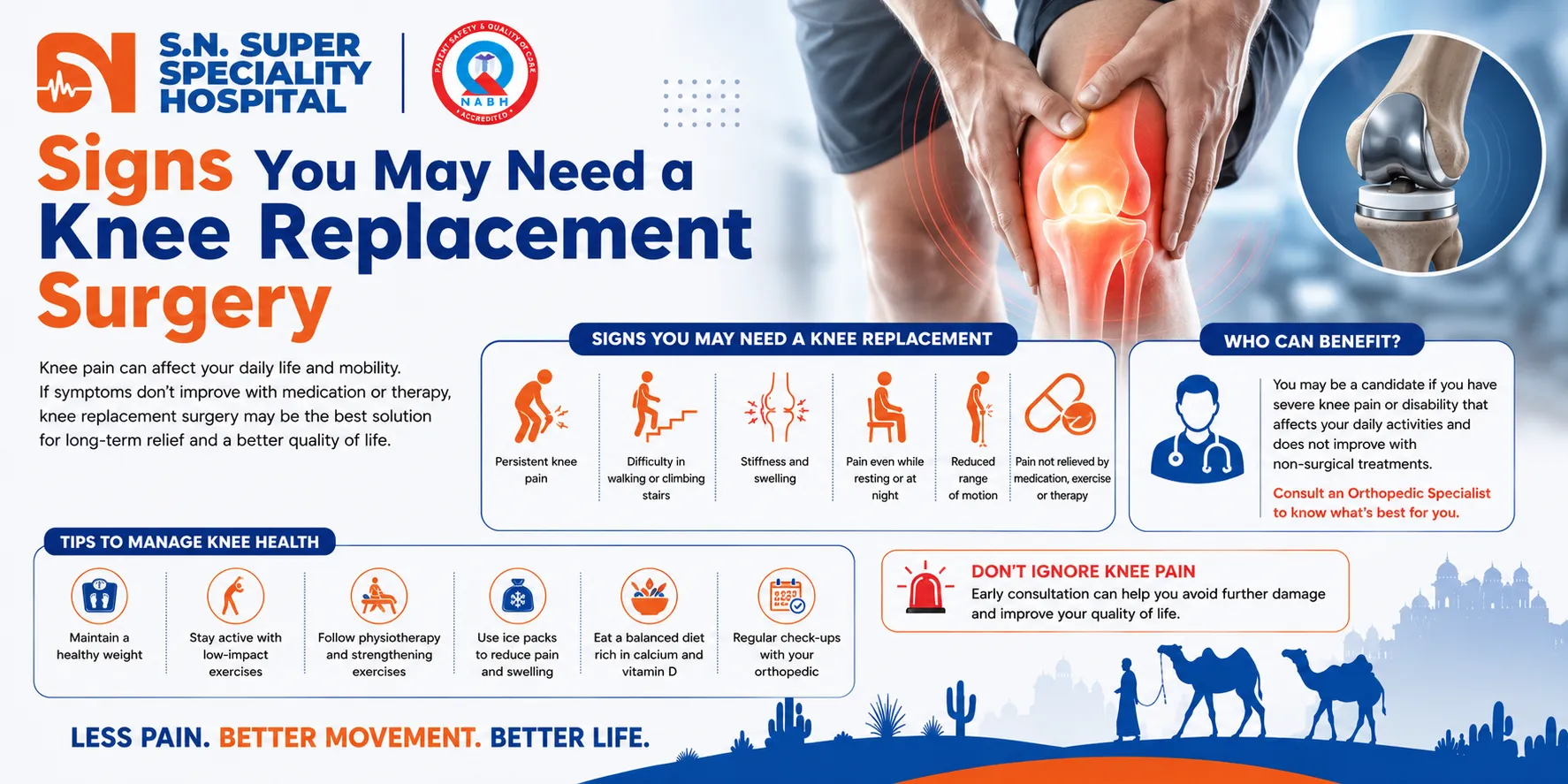
Signs You May Need a Knee Replacement Surgery
Knee pain has a way of creeping into every part of daily life. It changes how you climb stairs, how long you can stand in the kitchen, and even how well you sleep at night. For many people in Rajasthan, that quiet erosion of mobility is often brushed aside as “just getting older,” until the pain becomes impossible to ignore.
If you have reached that point, a conversation with the best orthopedic doctor in Sri Ganganagar can help you understand whether physiotherapy and medication are still enough, or whether knee replacement surgery deserves a serious look.
Knee replacement is not a decision anyone should rush into, and it is not the first option for most patients. But it is also one of the most studied and successful procedures in orthopedic medicine. According to the American Academy of Orthopaedic Surgeons, a large majority of modern total knee replacements are still functioning well more than fifteen years after surgery.
The real challenge is not whether the surgery works. It is knowing when your knee has told you, in its own way, that it is time.
Here are the signs you should pay attention to.
1. Your Pain Is No Longer Occasional
Everyone’s knees ache once in a while, especially after a long walk or a day spent squatting and kneeling. That is different from pain that shows up daily and lingers regardless of what you do. When discomfort becomes a constant companion rather than an occasional visitor, it usually points to advanced cartilage loss from osteoarthritis, rheumatoid arthritis, or an old injury that never fully healed.
2. Medications and Injections Have Stopped Helping
In the early stages of arthritis, anti-inflammatory tablets, steroid injections, and physiotherapy can offer real relief. These treatments manage symptoms, but they cannot regrow cartilage or reverse joint damage.
Many patients notice that the same dose or the same injection that once worked wonders now barely takes the edge off. When conservative treatment stops delivering results, it is a signal that the underlying joint damage has progressed beyond what medicine alone can manage.
3. Pain Disturbs Your Sleep
Daytime pain is hard enough, but pain that wakes you up at night or makes it difficult to fall asleep in the first place is a stronger warning sign. Rest pain often means the joint is inflamed even when it is not bearing weight, which usually reflects more severe degeneration than pain triggered only by movement.
4. Your Knee Is Frequently Swollen
A knee that stays puffy and warm to the touch, even after rest and medication, is telling you something. Persistent swelling is often a sign that the cartilage lining the joint has worn down enough to cause ongoing irritation, or that the joint itself has become unstable. An X-ray at this stage typically shows narrowing of the joint space that confirms what the swelling has already suggested.
5. You Notice Stiffness, Bowing, or Difficulty Straightening the Leg
As arthritis advances, it does not only cause pain. It can change the actual shape and alignment of the joint. Knees may start to bow outward or turn inward, a change often described as becoming “knock-kneed.” Some patients also find they can no longer fully straighten or bend the knee. Left unaddressed, this kind of deformity can become permanent, which is why early evaluation matters.
6. Everyday Activities Have Become Difficult
This is often the sign that finally pushes people to seek help. Climbing stairs, getting up from a low chair, walking to the market, or simply standing for a few minutes becomes a genuine struggle. When a knee starts controlling your choices instead of the other way around, quality of life becomes the deciding factor rather than pain alone. Orthopedic specialists generally agree that the timing of surgery depends less on age and more on how much the joint is limiting your daily function.
7. You Are Ready for a More Active, Independent Life
It may sound like an unusual sign, but readiness matters. Total knee replacement allows most patients to return to walking, light exercise, and recreational activities such as swimming or cycling, though high-impact sports are usually discouraged afterward to protect the new joint. If you find yourself avoiding family gatherings, travel, or simple outings because of your knee, that avoidance itself is worth discussing with a specialist.
Why the Right Facility Matters as Much as the Right Time
Deciding to undergo knee replacement is only half the equation. The outcome also depends a lot on where the surgery takes place, the experience of the surgical team, and the quality of post-operative rehabilitation.
An ortho care hospital in Sri Ganganagar that offers modern diagnostic imaging, a dedicated orthopedic unit, and structured physiotherapy support can make a measurable difference in how quickly patients regain mobility and confidence after the procedure.
Knee replacement surgery in India has grown rapidly over the past decade, and government health data points to a steady rise in joint replacement procedures as life expectancy and awareness both increase.
That growth has been matched by improvements in surgical technique, implant design, and recovery protocols, so patients today generally spend less time in hospital and return to independent movement sooner than earlier generations of patients did.
Talk to a Specialist Before the Decision Gets Harder to Make
There is no single test that tells you the exact day you need surgery. It is a decision built on a combination of factors: how much pain you are in, how well other treatments are working, how the joint looks on imaging, and how much your daily life has been affected. That is why an honest conversation with an orthopedic surgeon matters more than trying to self-diagnose from a checklist.
If your knee pain has reached the point where rest, medication, and physiotherapy no longer give you relief, it may be time to seek a proper evaluation. Families across the region increasingly look for care closer to home rather than travelling long distances for treatment, and the best hospital in Rajasthan for orthopedic and joint care can offer that combination of advanced treatment and personal attention without the added stress of travel.
Knee pain does not have to define how you move through the rest of your life. With the right guidance and the right timing, surgery can restore not just your knee, but your independence.
Comments are closed